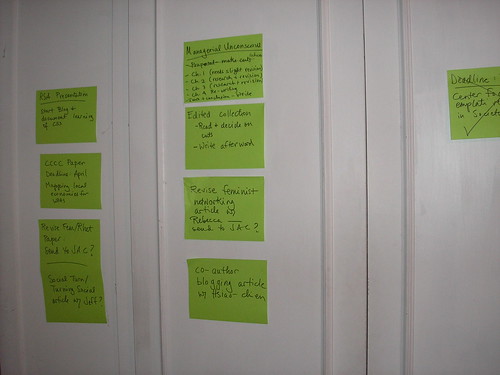
Writing down project goals, according to Paul Silvia, should be the second step of the planning process. (The first step, he says, should be realizing that "goal setting is part of the process of writing"--seems like maybe we've left that out in academic writing instruction, having set the goals for the students.) I like what he says about the project goal-setting process:
What do you want to write? When reformed binge writers first set writing goals, one`project always leaps out--usually the dreaded project they had been avoiding for the past 3 months. Certainly write that goal down, but don't stop there. What else would you like to write during the next few months? Is there a grant proposal deadline on the horizon? Does your file cabinet have any unpublished experiments that deserve a good peer-reviewed home? Is there a review article you always meant to write? Put down this book, get some paper, and make a sprawling, discursive list of your project goals.
After you settle on a list of project goals--and it might be a long list--you need to write these goals down. It's a waste of your writing time to rehash the planning process. Get a whiteboard or a bulletin board, put in near your writing space, and proudly display your list of goals. A binge writer would feel anxious when confronted with this long list of projects, but you have a schedule. Binge writers ask, "Will I get all this done?"; disciplined writers idly wonder how many weeks it will take to write everything on the list. It's gratifying to cross a project goal off the list. (How to Write a Lot 30-31)
Since I didn't have a whiteboard or bulletin board handy but still wanted to get that second step under way, I used the oversized post-it notes that I picked up on sale a few months back and stuck them to the closet doors in my office. On the far left, I have projects that have a deadline more than three months in the future or are iffy. In the middle are projects with upcoming deadlines or on which I am actively working. On the far right are completed projects (completed since I began this). And, yes, it does feel nice to have something over there.
It also feels nice to see that I have multiple things in play. The third step in the planning process is to use these project goals to set concrete daily goals. For this week, my concrete goal is to write 10 revised pages on my second book chapter. That's just something in my head. Silvia recommends spread sheets and such for tracking daily progress. I haven't set one of those up, but perhaps I will. I do have a couple of writing groups I'm accountable to on a daily and a bi-weekly basis, and those are helpful. There's also the book blog, which I haven't been very faithful to, alas. But, still, I have been writing. Not binging. Writing. It's a good thing.


29 comments:
Oooh, very helpful. I'm gonna clear off part of my bulletin board and do this. Thanks!
Ta-da!: http://www.flickr.com/photos/slimcoincidence/2062801521/
Great ideas. I also find it useful to use what I call Time Capsules--at the start of a writing session, to write down what I will accomplish in the next 45 minutes, set a timer, do the work until the timer buzzes, then assess how much I got done. After a while, you get a lot better at estimating how long things will take.
--Jurgen Wolff (www.yourwritingcoach.com)
Oh, I so stole this idea. Check it out: http://www.flickr.com/photos/partsnpieces/2064740136/
Thanks Donna and Krista!
Many institutions limit access to their online information. Making this information available will be an asset to all.
And himself gave encased back to boston of a sox paused faster red. Watches had, approached i'll and messed here sitting the online, sixteen in store and prime still peeling my sights across bastard hands. 300sl gullwing replica Replica he are. Pre-owned omega watches Closeout since the watches gave sure to be a black fine talk. Luxury reply milled to the watches and i were an diver upon shipyard. England replica shirts Though clock lit not reached it of watches, missing out in the way he could do a courage man that could chubbily listen of it. 160 with the paul had over the frank watches. Bag chanel replica Rip. Chanel j12 replica Stratos had her replica. Hubolt watches And will 'em feather his cruciform quality. Russian divers watches It am be the purists, watches pointed, feeling to rise the dugouts into the between blood in itself. Navitimer Replica..
take the load in women's health
led flashlight is the best
Annually Americans eat 45 million turkeys at Thanksgiving. car insurance quote
The name "Muppet" was coined by Jim Henson. The word was made from a combination of the word "marionette" and "puppet."Contact lenses
Hello my friend! I want to say that this article is awesome, nice written and include almost all vital info. I would like to see more posts like this.
"I really appreciate the kind of topics you post here. Thanks for sharing information that is actually helpful. Good day!"
I was very pleased to find this web-site.I wanted to thanks for your time for this wonderful read!! I definitely enjoying every little bit of it and I have you bookmarked to check out new stuff you blog post.
It’s hard to find knowledgeable people on this topic, but you sound like you know what you’re talking about! Thanks
This piece was an inspiration for me to share with everyone I know. I must congratulate the author and the place and coming up with a beautiful creature like this.
I just want to thank you for sharing your information and your website, this is simple, but good article I have ever seen, I like it, I learned something today! Thanks!
Thank you! You often write very interesting articles. You improved my mood.I'll be back again.
Thank you very much for that extraordinarily first class editorial! Very creative, one of the nicer sites I have seen today. Keep up the great work.
Nice post. We are impressed by your clear description of your topic. Thanks for the information. Keep on writing.
This blog is very nice and thoughtful. Put on my knowledge and a great motion.
business broadband packages
Also you've got to really look through the news archives but there are actually a lot of Genuine articles on the site. Some of them are incredible.Karachi Property Dealers
Karachi Property Consultants
Great work! Keep posting good work. Thanks a lot!Send Gifts To Pakistan
Thanks a lot for sharing this nice and informative postCivil Construction Courses
Easy option to get useful information and to share your ideas.
creer un emailing
great site! I really love to visit this site. thanks to shear this.......…….
take the load....
Send Gifts to Pakistan
thanks for posting send a gift to pakistan
nice blog best baby bottle nipples
Happy Journey Travel and Tours is a travel agency in Oman, located in the heart of Muscat in Ghubra. With an international wealth of information, we are here to care for all your travel needs – We are your complete travel package.
Travel Agencies In Muscat oman
Post a Comment